

The Notification I Didn't Answer for Three Hours
There is a text sitting unread on my phone right now. The anxiety I felt about NOT responding to it? That taught me something I had to share with you.

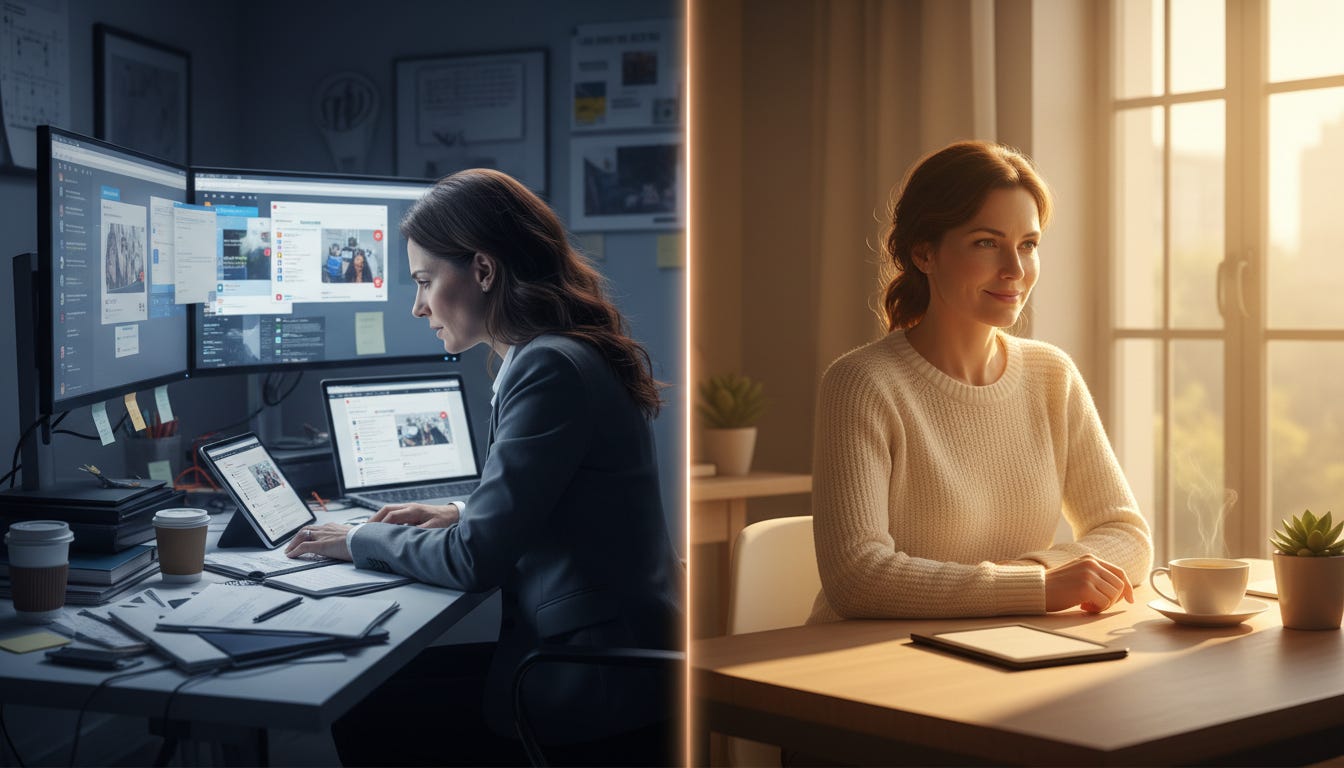
There is a text sitting unread on my phone right now.
It has been there since this morning. It is not urgent. It is not from someone in crisis. It is a forward from a well-meaning contact - the kind that starts with “I thought you’d find this interesting!” followed by three articles I will not read.
I know this. And I still felt a low hum of anxiety every time I thought about it.
I am the Squirrel Wrangler. I teach nervous system regulation for a living. And I spent part of my morning mildly stressed about a text I had already decided not to prioritize.
That is Techxiety™ in action - and it happens to all of us.
Today on Show Me Your Nuts, we went deep on something I call the Hidden Cost of Constant Connectivity. I want to bring that conversation here, into your inbox, because I think it deserves more than a livestream moment. It deserves your undivided attention. Which is exactly the thing we have been training ourselves to fragment.
So let’s talk about it.
The Always-On Body
Here is what the research says and what twenty-five years of clinical work confirms: your nervous system does not distinguish between a work emergency and a meme from your cousin. It just sees a notification. And it spikes accordingly.
Every ping is a micro-stressor. One or two? Handled easily. Sixty before noon? You are running a cortisol tab that never gets paid off - because the next notification arrives before your body finishes processing the last one.
Research on digital burnout shows that the alert state stays active as long as a device is nearby - even face-down, even silenced. Proximity alone is enough to keep your threat-response system on standby.
Pause here. Reflect: How many times did you check your phone in the last hour? What emotion preceded each check - was it habit, boredom, anxiety, or genuine need?
What I Used to Tell Myself
I used to believe that being responsive was a sign of care. That answering quickly meant I valued the people reaching out. That staying plugged in was a form of respect.
What I did not see was the cost. Not just to my nervous system, but to the people in front of me. Because when I was always half-available to everyone online, I was never fully present to anyone in the room.
The shift for me came when I stopped asking “am I being responsive?” and started asking “am I choosing this response right now, or is the notification choosing for me?”
That question - am I choosing this, or is it choosing me? - is the foundation of every digital boundary I have built since.
Natural Endpoints: The Insight That Changed How I Design My Days
During today’s show, an audience member named Jessica made an observation that stopped me mid-sentence. She said something like: “When we’re in a physical space, there are natural exits - doors, endings, goodbyes. Online, there is no exit. Just more content.”
She is right. And that design is not accidental.
Infinite scroll, auto-play, red notification badges - these are deliberate architectural choices by platforms that profit from your continued engagement. They have removed the natural endpoints that human social interaction has always had.
Your walk home from work used to be the transition. Your commute had a beginning and an end. Dinner was dinner, not dinner-plus-second-screening.
Now the transition never comes - unless you build it yourself.
This is why I started using what I call Analog Wind-downs: a 60-minute window before bed with zero screens, during which I transition from digital-brain to rest-brain. Not because I am anti-technology. Because I am pro-sleep, pro-clarity, and pro-showing-up-well tomorrow.
The Productivity Lie
We have been sold a story that availability equals professionalism. That the faster you respond, the more valuable you are. That the person who answers emails at 11 PM is “committed.”
Here is the truth: the person answering emails at 11 PM is not more committed. They are more depleted. And a depleted professional makes worse decisions, communicates less clearly, and is less emotionally available to their clients, colleagues, and family.
The APA’s research on stress and technology consistently shows that adults who report the highest digital obligation also report the lowest sense of personal control. You cannot lead, coach, or care for others from that state.
What actually signals professionalism? Protecting your capacity so you can show up as your best self when it counts.
I went deep on five specific strategies for doing exactly that in this week’s companion piece on the Noomii Blog: 5 Hidden Costs of Constant Connectivity (And How to Reclaim Your Peace). It’s written for coaches, therapists, and high-achievers who need this to be practical, not preachy.
The 1-10 Check-In (And Why It Works)
During the live show today, I led viewers through a real-time energy check. I asked everyone to rate their current tech-overwhelm on a scale of 1-10 - 1 being “I feel completely present and clear,” 10 being “I am one notification away from throwing my phone into a lake.”
The answers ranged from 4 to 9. Nobody said 1.
That tells me something important: most of us are walking around at a 5 or 6 as our baseline. We have normalized the static. We have stopped noticing the hum because it has become the background of our entire day.
The practice of naming it - out loud, on a scale - creates enough separation to ask: “Do I want to stay here?”
Try it right now. No really. What is your number?
Reflection: What would it feel like to move that number down by two points before dinner tonight? What would need to change?
What This Is Really About
Techxiety™ is not just about phones. It is about permission.
Permission to close the laptop at 5 PM. Permission to not respond until morning. Permission to be unreachable for sixty minutes while you do something that restores you. Permission to value your attention as a resource rather than a service you provide on demand.
That permission does not come from outside. It comes from a decision you make about who you are and what you are protecting.
You are not your response time. You are the quality of thought and care you bring when you do show up.
That is worth protecting.
Discussion Questions
What emotion comes up when you imagine leaving your phone in another room for two unstructured hours - anxiety, relief, guilt, something else?
Do you feel more “complete” after an in-person conversation or a digital one? What does that tell you about your nervous system’s needs?
Where did you learn that being always reachable was a virtue? Is that belief still serving you?
What is the one notification you would not miss if it disappeared?
If your attention is a resource, how are you currently investing it - and is that investment returning value?
If you want to go from scattered to strategic - one tiny powerful shift at a time - come join me live every Thursday at 11:30 AM ET on Show Me Your Nuts. No scroll. No replay trap. Just real conversation with a real community.
And if you are ready for personalized support, let’s talk.
Stacy Braiuca, LCSW | The Squirrel Wrangler™
GotTechxiety? I solve that.
Clinical Social Worker with 25+ years of experience helping humans reclaim their focus, one acorn at a time.
References